








Sustainability has become an important consideration in women’s footwear development. For brands exploring eco-friendly knit shoes, however, choosing a more responsible product involves more than selecting a knitted upper or using natural-looking colors.
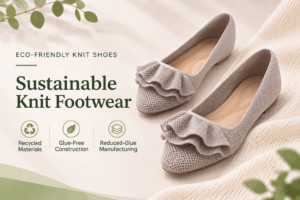
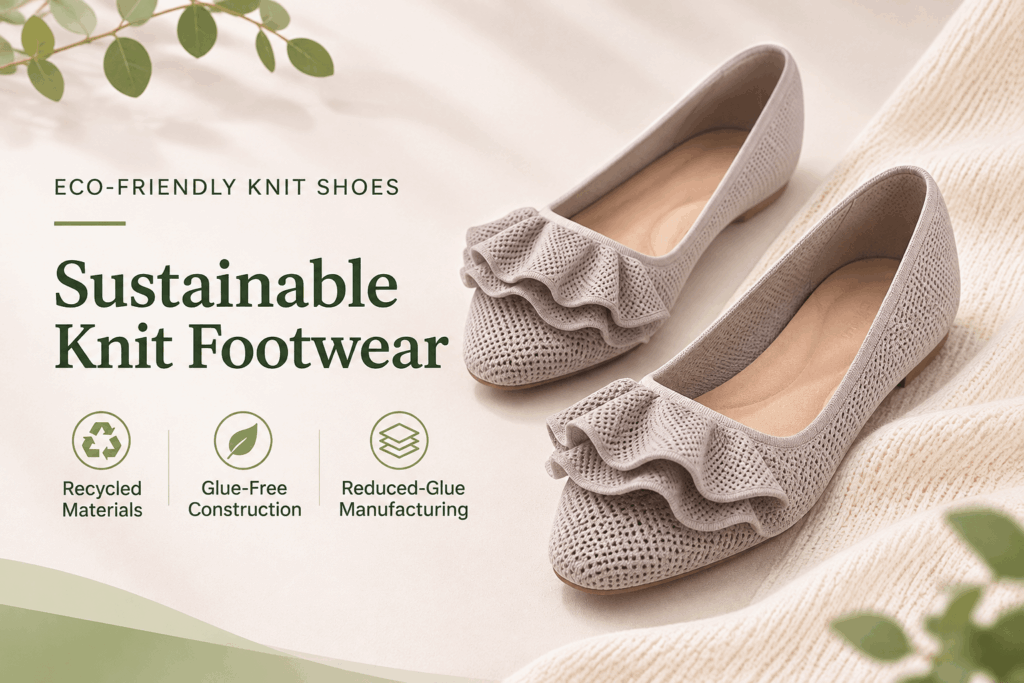
Two approaches frequently discussed in sustainable footwear manufacturing are recycled materials and glue-free or reduced-glue construction.
They address different aspects of shoe production, and understanding the difference can help footwear brands make better sourcing and product development decisions.
What Makes a Knitted Shoe Eco-Friendly?
There is no single feature that automatically makes an entire shoe environmentally friendly.
A footwear product contains several components, including the upper, lining, insole, outsole and materials used to connect them. Each component can influence the product’s overall environmental profile.
For OEM and private-label buyers, three practical areas deserve attention:
- Material selection: Whether recycled or other lower-impact material options are available.
- Construction methods: Whether adhesive use can be reduced or certain components can be assembled without glue.
- Product durability: Whether the finished shoe meets its intended wear and quality requirements.
These considerations should be evaluated together rather than treated as independent marketing claims.
Brands interested in different development approaches can explore Shuyi’s Eco-Friendly Knit Shoes collection.
Recycled Knit Shoes: Focusing on Material Selection
Recycled knit shoes incorporate yarns or other components made using recovered materials.
Depending on the supplier and the product specification, recycled material options may include recycled polyester or other recycled fibers.
The potential advantage is the opportunity to reduce reliance on virgin raw materials. However, recycled content alone does not establish that the entire shoe has a lower environmental impact.
What Buyers Should Verify
When evaluating recycled knitted footwear, ask the manufacturer or material supplier:
- Which components contain recycled materials?
- What is the recycled content percentage?
- Is the recycled material content supported by documentation?
- Does the selected yarn meet the required appearance and performance specifications?
- Can the same material be sourced consistently for repeat orders?
These questions are particularly important when recycled content will appear in product descriptions, packaging or sustainability-related marketing.
For example, Shuyi offers women’s recycled knit flats for sustainable footwear collections as a product development direction for brands interested in recycled-material footwear.
The exact recycled fiber type and content should be confirmed for the final approved production specification.
Glue-Free Knit Shoes: Focusing on Construction
While recycled footwear focuses primarily on material sourcing, glue-free construction addresses how shoe components are assembled.
Traditional footwear production may use adhesives to connect uppers, soles or other parts. Glue-free approaches seek to replace certain adhesive-bonding operations with alternative construction methods.
Depending on shoe design, possible approaches may involve stitching, mechanical connections or other assembly techniques.
However, not every footwear style can use the same construction method.
The compatibility of the upper, sole, product shape and intended application must be evaluated before confirming whether a glue-free design is feasible.
Glue-Free Does Not Automatically Mean Fully Sustainable
Removing adhesive from one stage of manufacturing does not necessarily eliminate every environmental impact associated with a shoe.
Material composition, manufacturing energy, product life and end-of-life treatment also matter.
For this reason, brands should distinguish between a verified glue-free construction claim and a broad sustainability claim.
Shuyi’s women’s glue-free knit flats with bow detail provide a reference style for discussing glue-free development options.
The final construction method should be confirmed during sampling and technical evaluation.
What About Reduced-Glue Manufacturing?
A third approach is reduced-glue construction.
This does not necessarily eliminate adhesives. Instead, the objective is to evaluate where adhesive use may be reduced while maintaining the required construction quality.
For certain footwear designs, this may be a more practical development option than attempting to remove all adhesive bonding.
From a buyer’s perspective, the important questions are:
- Which manufacturing stages use adhesives?
- Can adhesive application be reduced without affecting product performance?
- Does the alternative construction require different materials or equipment?
- How will the revised design be evaluated during sampling?
- What documentation can support any claims made about the finished product?
A reduced-glue approach should be described accurately. Products should not be marketed as completely glue-free unless the actual production construction supports that claim.
Recycled Materials vs Glue-Free Construction: Which Should You Choose?
The two approaches are not direct substitutes.
They address different product development decisions.
| Consideration | Recycled Materials | Glue-Free Construction |
|---|---|---|
| Primary focus | Material sourcing | Product assembly |
| Main decision | Which recycled fibers or components to use | How components are connected |
| Important verification | Material composition and recycled content | Actual construction and adhesive use |
| Development challenge | Material availability and consistency | Construction feasibility and performance |
| Buyer documentation | Material specifications and relevant evidence | Construction specifications and test results |
Choose recycled-material development when: Your brand’s priority is sourcing specified recycled fibers or components with appropriate supporting documentation.
Explore glue-free construction when: Your product concept places particular emphasis on reducing reliance on adhesive-bonding methods.
Consider reduced-glue development when: You want to investigate practical construction alternatives without assuming that all adhesive use can be eliminated.
These approaches may also be combined where technically feasible.
Designing Eco-Friendly Knit Shoes That Customers Actually Want
Sustainability-oriented development should not come at the expense of a product’s intended use or visual appeal.
Women’s footwear brands still need attractive silhouettes, suitable fitting, consistent finishing and recognizable product details.
A simple knitted flat can serve as a starting point for multiple design directions.
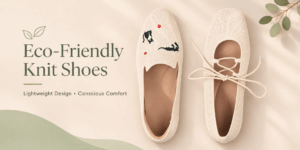
For example, Shuyi’s eco-friendly knit flats with decorative knit detail show how a lightweight knitted upper can be paired with a more fashion-oriented appearance.
Brands exploring decorative styles may also consider sustainable knit flats with 3D flower detail as a reference for their collection development.
These examples illustrate styling possibilities; the environmental attributes of any final production version still depend on its confirmed materials and construction.
A Practical OEM Development Checklist
Before asking an eco-friendly footwear manufacturer for a quotation, prepare a clear project brief.
Step 1 — Define your product concept
Specify whether the project involves casual flats, lifestyle footwear, fashion-oriented knit shoes or another women’s footwear category.
Step 2 — Identify the sustainability priority
Decide whether recycled materials, glue-free construction or reduced-glue methods are the primary development focus.
Step 3 — Share material and design requirements
Provide reference images, preferred colors, outsole requirements, sizing information and any relevant material specifications.
Step 4 — Evaluate samples
Review the knit texture, shoe appearance, fit, upper-to-sole construction and finishing. Confirm whether the proposed materials and construction are suitable for the intended product.
Step 5 — Confirm claims and documentation
Request the information necessary to support any recycled-content, material or construction statements that will appear in your marketing.
Step 6 — Approve specifications before bulk production
Ensure the final materials, construction method and sample details are clearly documented.
At Shuyi Footwear, our OEM and ODM customization services support brands in discussing material options, footwear designs and product development requirements.
Buyers can also explore our footwear craftsmanship and manufacturing processes to better understand production capabilities.
Quality Control Still Matters for Sustainable Footwear
A promising material or construction concept is only one part of successful production.
For eco-conscious knit shoes, buyers should also pay attention to consistent materials, appearance, fit and workmanship.
Shuyi Footwear incorporates incoming material inspection, in-process quality control and final product inspection into its manufacturing operations.
These stages help monitor production quality, but environmental claims and specialized performance requirements may need additional supporting documentation or testing depending on the product and destination market.
Develop Your Next Eco-Friendly Footwear Collection with Shuyi
Recycled knit shoes, glue-free footwear and reduced-glue construction each offer different possibilities for women’s shoe development.
The best approach is the one that matches your brand’s product requirements, sourcing priorities and verified manufacturing specifications.
Shuyi Footwear supports international footwear brands, importers and retailers with women’s knitted shoe manufacturing and OEM/ODM development.
Explore our eco-friendly knitted footwear products or contact Shuyi Footwear to discuss your design ideas, material requirements, expected order quantity and development goals.